Why Ants Keep Coming Back After You Spray
You sprayed the line of ants on the counter. They died. Two days later there's a new line in the same spot.
That's not bad luck and it isn't a bad product. It's what happens every time you treat the ants instead of the colony.
What you're actually looking at
The ants on your counter are foragers, and they're a tiny fraction of the colony. Depending on the species, somewhere around 5 to 10 percent of the colony is out looking for food at any given moment. The rest, including the queen and the brood, are somewhere you can't see: under the slab, behind a wall, in the soil against your foundation, under the mulch by the front step.
Kill the foragers and the colony notices it's short on foragers. So it sends more.
Worse, most contact sprays are repellent. The surviving ants read the treated area as dangerous and simply route around it. You haven't reduced the colony. You've taught it a new path into your kitchen, often through a wall void where you'll never see it.
Why the trail comes back to the same spot
Ants navigate by pheromone trail. When a forager finds food, it lays a chemical line back to the nest and every ant that follows reinforces it.
Wiping the counter removes crumbs. It doesn't remove the trail. Unless you've broken down the pheromone with soap and water or a vinegar solution across the entire path, including the baseboard and the wall behind the counter, the highway is still there.
That's why the new line shows up in the exact same place. You cleaned the destination and left the map.
The species matter in St. Louis
Three do most of the damage around here.
Odorous house ants are the small dark ones that smell faintly like blue cheese when crushed. Their colonies have multiple queens and they split when stressed. Spray them with a repellent and one colony can become several. This is the single most common reason a DIY ant problem gets worse instead of better.
Pavement ants nest under driveways, patios and sidewalk slabs and come up through expansion joints. The nest is under concrete, which means surface spray never reaches it.
Carpenter ants are the big black ones. They don't eat wood, they excavate it, and they're only interested in wood that's already damp. A carpenter ant problem is usually a moisture problem wearing a costume: an overflowing gutter, a bad deck ledger, a window that's been leaking quietly for two years.
What actually ends it
Non-repellent products and bait, not contact killers.
Non-repellents are the important half. Ants can't detect them, so they walk through the treated zone, pick up the active ingredient and carry it back into the nest on their bodies. They groom each other. They feed each other. The product moves through the colony including to the queen, which is the only part that matters.
Bait works the same way with a different delivery. The forager thinks it found dinner and takes it home.
Both are slower than a can of spray. You'll still see ants for a few days, and that's the point. An ant that dies instantly on your counter never makes it home.
What we do differently
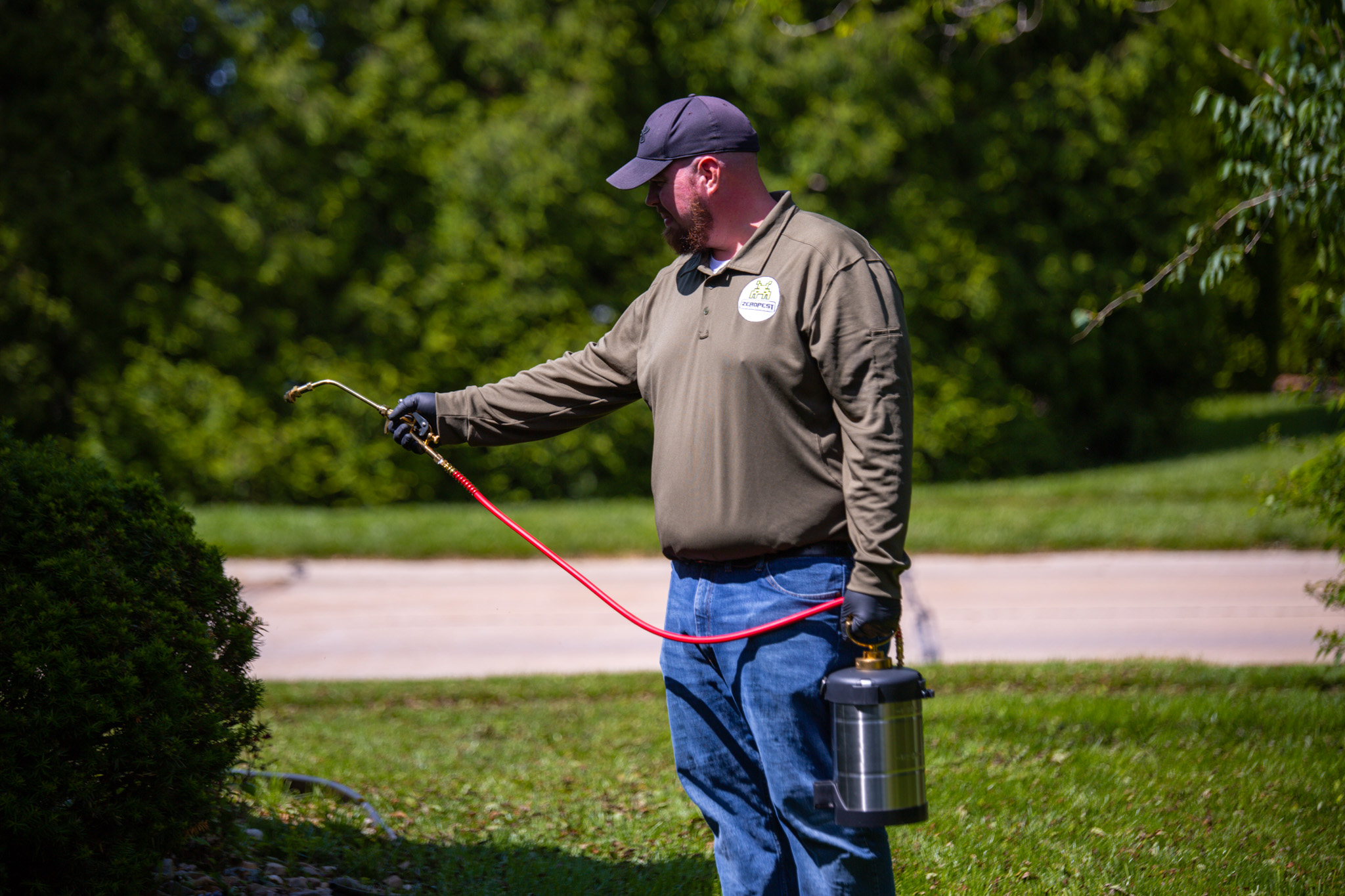
On a Home Shield visit we treat the perimeter with a non-repellent barrier, put granule down at soil level where ants actually travel, and treat the entry points: foundation cracks, doorways, utility penetrations, the gaps where the deck meets the house.
Interior work is targeted. We're not fogging your kitchen. We're doing crack and crevice applications at the specific points where the trail is coming through, which is usually a lot less spraying than people expect.
Then we come back. Ant colonies are persistent and the exterior product needs refreshing roughly every 90 days. Between visits, if the ants come back, so do we at no extra charge.
What you can do yourself that actually helps
Wipe trails with soap and water or a 50/50 vinegar solution, along the whole path, not just where you saw them.
Cut back anything touching the house. Shrubs, mulch piled against the foundation, tree limbs on the roof: they're all bridges.
Fix the moisture. If you've got carpenter ants, find the water before you worry about the ants.
And resist the urge to spray the trail. Especially with odorous house ants, that's the move that turns one colony into four.
Frequently asked questions
Why do ants come back after I spray them?
Because spray kills foragers, which are a small fraction of the colony, and leaves the queen and brood untouched. Most store-bought sprays are also repellent, so surviving ants route around the treated area instead of dying, often through wall voids where you can't see them.
Does killing ants attract more ants?
Indirectly, yes. Crushed ants release alarm pheromones, and a dead ant left in place can attract others. More importantly, a colony that loses foragers responds by sending out more.
How long does it take to get rid of ants for good?
With colony-targeting products, expect noticeably less activity within 3 to 7 days and control within 2 to 3 weeks. Full elimination often takes a couple of treatment cycles, because colonies near the structure keep repopulating until the barrier is established.
How much does ant control cost in St. Louis?
Ants, including carpenter ants, are covered by our quarterly Home Shield plan: $45 a month for most homes, with most first visits $175 after the $100 new-customer discount. See our pricing for details.
Are the products safe around kids and pets?
Yes, once dry, which takes about 30 minutes. We use commercial-grade products applied by licensed commercial applicators, and we place everything with kids and pets in mind.
Tired of the same line of ants on the same counter? Get a free quote or call (314) 912-2929, and read more about ant control in St. Louis.

